On the evening of Friday 14 May 2010, I received a PDF from the BBC. Eighteen pages of screenshots, trademark registrations, and a demand: remove beebPlayer from Android Market. What I had started as a Python script had become an Android app installed on over 50,000 phones, but the BBC’s lawyers were somewhat less impressed.
beebPlayer was born from scratching an itch. Three years earlier, on Christmas Day of 2007, the BBC had launched iPlayer. At last we could enjoy shows like Top Gear and Doctor Who in high-definition video, streamed right over the internet directly to our PCs from the comfort of our… desks?!
No, that wouldn’t do. I didn’t want to sit at my desk to watch Spooks! I wanted to enjoy it on the sofa, or on the train! Surely there had to be a way…
2008 - Xbox
By March 2008 I had found a way, courtesy of my modded Xbox running Xbox Media Center (aka XBMC, but now Kodi) which just happened to be perfectly suited for this challenge. Crucially, it had allowed me to create a plugin that could communicate with iPlayer and stream TV shows just like the BBC’s official app.
Over the course of the year I shared my improvements via Google Code, heralding subtle user experience improvements such as being able to search for the thing you wanted to watch, and not having to wait for the entire thing to download before you could actually watch it. For good measure, I threw in some hot pink theming, dropped in some channel logos, and hey presto - iPlayer on an Xbox, and perfect for use from a sofa, desk be damned.
My efforts did not go unnoticed by the BBC - I was kindly invited by Ian Forrester to cram my Xbox into a backpack, lug it all the way across London and drop in on their engineering offices in White City to demonstrate it to the actual designers and engineers who had built the real iPlayer:
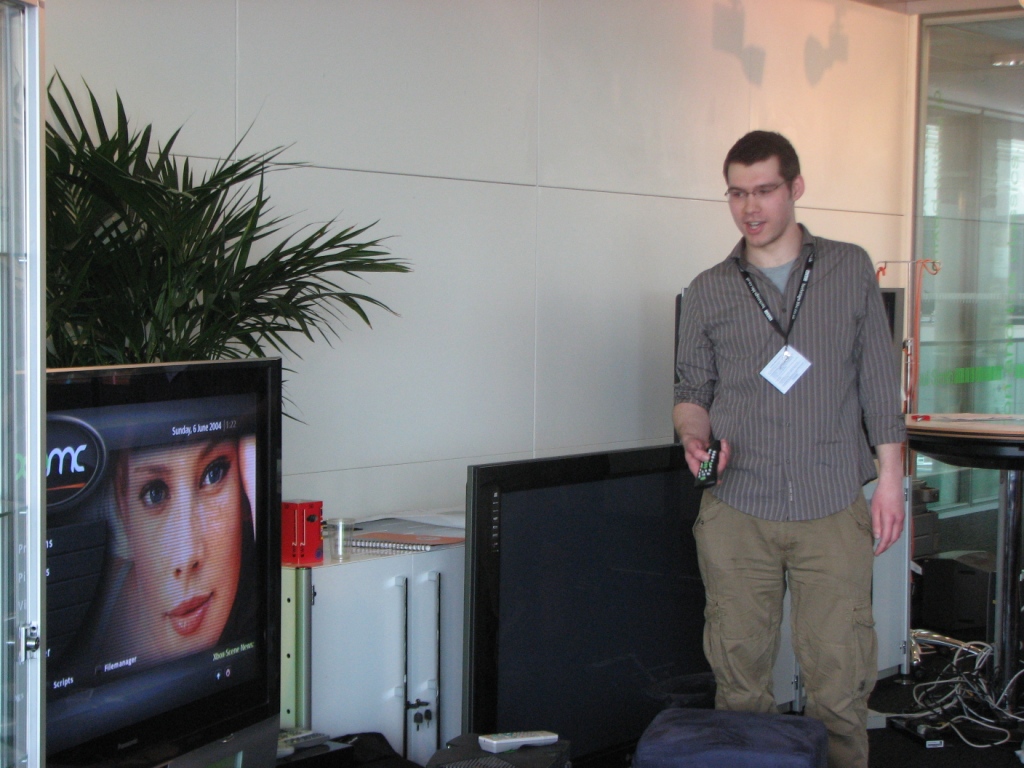
Photo by Ian Forrester, showing my iPlayer plugin running on XBMC at the BBC demonstration. View the full album.
I headed home assuming that was the last interaction I’d have with the BBC.
So, now I could watch iPlayer at my desk or on my sofa. What about on a train, or a bus? I had a Nokia N800 which I could probably have written an app for, but something far more exciting was looming large on the horizon…
2008 - Android
In November 2008, the first Android phone landed - the HTC Dream - and I had to get one. I simply couldn’t wait to watch iPlayer content on my phone, on the move, just as my iPhone-wielding friends were able to.
Except… there was no BBC iPlayer app for Android; iPlayer was strictly limited to iPhone. I was iPlayer-less and, worst still, the BBC had no imminent plans to launch iPlayer for Android.
Well, reader, you can imagine what I did next…
2009 - beebPlayer
In April 2009 (at least when I wasn’t trying to build multiplayer maps out of rusty shipping containers) I published “beebPlayer”, a free Android app carefully pink-themed, priced and named to allow Android owners to use iPlayer on their phones, just as XBMC users had been able to on their Xboxes. By May it was published on Android Market (today known as “Play Store”), and before long it had - terrifyingly - been installed on tens of thousands of devices.
My inbox (no, not that one) started to fill with feedback and automated crash reports from users. I tried my best to reply to each and every one as best I could but, for most people, the app appeared to work well enough to let them enjoy iPlayer content on their Android phone, and the app enjoyed a good star rating from reviews. Meanwhile, I patiently awaited the official app from the BBC, which would certainly, definitely, most absolutely be better than my amateur attempt, allowing me to put beebPlayer to bed and redirect users to what was obviously going to be a better solution.
2010 - Takedown
As it turned out, beebPlayer was not the temporary iPlayer-on-Android answer that the BBC was looking for - and shortly after 5pm, on the evening of Friday 14 May 2010, just as I was heading home from work, I received an unexpected e-mail from the BBC’s “IP Litigation” department. Inside the email was a rather large PDF. I opened it. I read it. Gulp.
Inside, I learnt that not only was the “Beeb” in “beebPlayer” a registered BBC trademark, but so was the hot-pink styling (or in lawyer-speak, “black and magenta trade dress”) of iPlayer that I had adopted for beebPlayer too. In addition, beebPlayer’s use of their various iPlayer APIs was, as far as the BBC concerned, in violation of BBC’s terms and conditions. Included were screenshots of my app, evidence of its reach, and for good measure, the actual “Beeb” trademark documentation - presumably in case I didn’t believe them.
The PDF ended with a clear and direct request to immediately remove beebPlayer from Android Market and cease all further distribution of the application.
Panicked, I rushed to my laptop to make amends. I genuinely felt that beebPlayer was above board. Something the BBC would definitely want to exist, or at least quietly tolerate…
A few shaky clicks around the Android Developer Console later, and beebPlayer was gone. This was not the end I had planned.
Now, perhaps a less panicked version of myself would have consulted a lawyer before doing any of this. Maybe there was a perfectly legal fallback or lawful mechanism by which I could have kept beebPlayer up. In retrospect, I should have seen this coming from the outset. But, in that moment, I did not feel like exploring the limits of the BBC’s legal department lest I somehow landed in deeper trouble, forbidden from watching Spooks or another David Attenborough documentary from the Beeb ever again.
By morning, the installation numbers via Android Market had tanked - but the incoming emails had risen dramatically. I set up an auto responder, clarifying that beebPlayer was “discontinued”. In return, I received some annoyed moans (and even more support requests, including demands for a working APK), but also many messages of thanks and goodwill from those who had enjoyed using the app and were simply sad to see it go.
I was sad, too - all I’d wanted was to watch iPlayer on my phone. Perhaps I should have kept it at just that - my phone, rather than offering it to others as well. Sure, it was a buzz to have a popular Android app - but I definitely should have considered the legal ramifications first, and that was a serious lesson learnt.
2011 - Resolution
In February 2011, the BBC launched their own iPlayer app for Android and much rejoicing was had (although, honestly, I think we all saved the real rejoicing for late 2015 when it finally dropped Flash).
I never heard back from the BBC’s lawyers, but I did finally get iPlayer on my phone, and I’ve been using it from the sofa, or on the train, ever since.